
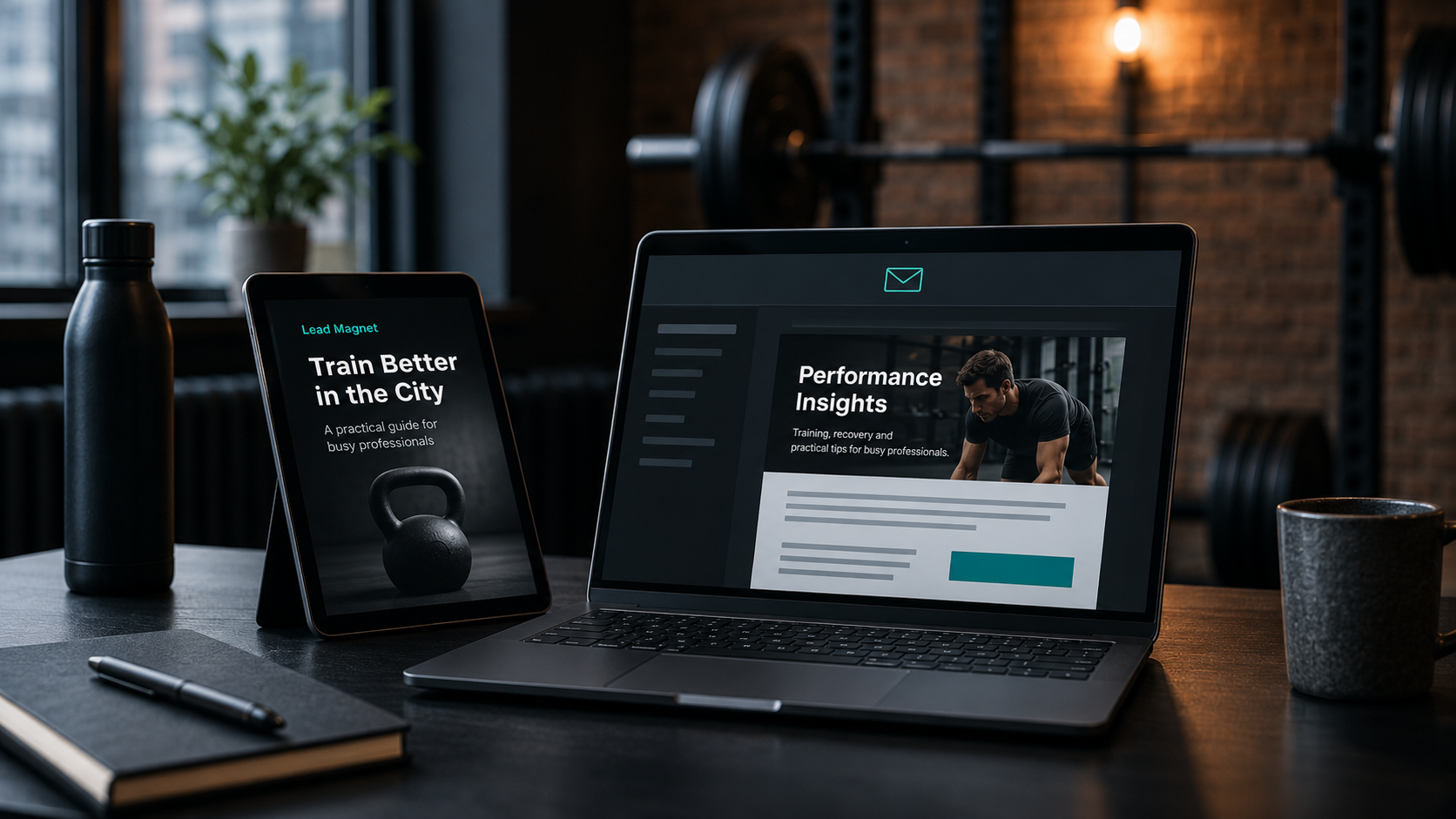
Most trainers start an email list the same way. A “join my newsletter” box goes in the footer, a handful of people sign up, two emails go out, and then it quietly stops. Sound familiar? The list was never the problem. The offer and the follow-up were.
So this guide looks at what the evidence actually says: which lead magnets convert, whether a newsletter can do the job on its own, what changes if you train people in person rather than online, which email platform is worth paying for, and the UK consent rules you need to get right. I run a PT studio in the City of London and two coaching brands of my own, so I’ve written it from the trainer’s side. Where I quote a number, I name the source, because a lot of the figures repeated online don’t have one.
Why the footer box doesn’t work
A lead magnet is anything you give someone in exchange for their email address: a guide, a checklist, a quiz result, a free session. It works because it answers a question they have right now. A newsletter signup asks for something different. It asks them to commit to an unknown number of future emails, about an unknown subject, from someone they’ve only just found. That’s a harder sell.
Where the form sits matters as much as what it offers. MailerLite analysed over 41,000 signup forms in 2026 and found that forms embedded in the page converted at 24.4% of views, against 9.0% for pop-ups. So a form inside a relevant blog post, or on your services page, will usually beat one that interrupts people while they’re reading.
Which lead magnets convert best
MailerLite’s dataset is the most useful one I’ve found. It measured signups as a share of form views, across forms that had at least 100 conversions each.
| Lead magnet type | Conversion rate |
|---|---|
| Giveaways | 29.4% |
| Courses, webinars and challenges | 27.4% |
| Quizzes and calculators | 26.4% |
| Reports | 24.6% |
| Consultations, calls and audits | 23.3% |
| Ebooks and guides | 23.2% |
| Templates | 21.1% |
| Waitlists | 19.0% |
| Newsletter only | 17.5% |
| Discounts | 16.2% |
Source: MailerLite, March 2026. The average across all types was 22.2%.
Now, a few caveats before you lean on these numbers. They’re cross-industry, with no fitness split. Only forms that already had 100 conversions were counted, which flatters every category. And the categories were assigned by keyword, so “challenges” and “courses” share a bucket. Treat the order as a guide rather than trusting the exact percentages.
Two things still stand out. Discounts come last, which matches what most trainers find in practice: “10% off your first block” attracts bargain hunters, not committed clients. And a plain newsletter sits near the bottom, which brings us to the real question.
Numbers to ignore
You’ll see claims like “lead magnets increase signups by 200 to 400%”, “gated ebooks convert under 1%” or “quizzes convert at 10 to 15%”. I couldn’t trace any of them back to an original study; they just get passed between statistics roundups. If a figure doesn’t come with a named dataset and a sample size, don’t build a plan around it.
Can your newsletter be the lead magnet?
Yes, with one condition. In MailerLite’s data, newsletter-only forms converted at 17.5% against an average of 22.2%. That’s a real gap, roughly a fifth fewer signups, but it isn’t fatal. And a newsletter has one thing a PDF doesn’t: it keeps working after the first email.
What closes the gap is being specific. Compare these two:
- “Sign up to my newsletter.”
- “One email every Friday: a 20-minute session you can do at home, and one thing I’ve changed my mind about this week.”
The second tells the reader exactly what they’ll get, how often, and why it’s worth a place in their inbox. That’s a lead magnet in its own right. Two things make it work. First, name the format and the cadence (the day, the length, what’s in it), then keep that promise. Second, send your best piece of content as the welcome email, so the signup pays off straight away, the same way a downloadable guide would.
If you want both, the common pattern is a specific freebie that leads into the newsletter. Someone downloads the guide, then gets the weekly email after it. You get the higher conversion rate of a specific offer and the ongoing contact of a newsletter.
In-person and online trainers need different offers
If you train people in person
Your prospects live or work within a few postcodes of you, and the decision in front of them is whether to start training with you. So there are really two things to get right: the first step someone books, and what you offer for an email address before they’re ready to book.
The first step
The usual advice is a free consultation, and it works for a lot of trainers. But it isn’t the only option, and if you work at the premium end, giving the first session away can sit awkwardly next to the price you’re asking. Plenty of high-end trainers don’t do free consults at all.
The alternative is a paid first session or assessment, run so it’s worth paying for: a proper assessment and a written plan the client keeps whether or not they carry on. Gym and studio software companies regularly claim that paid intro offers turn into ongoing clients more often than free ones, but none of the figures I found come with a published dataset, and they don’t agree with each other, so treat that as a direction rather than a fact. There’s a little academic support for the idea. A 2026 experiment in the Korean Management Review found that charging a token price for a trial class raised people’s sense of its value, and their stated intention to go, compared with offering it free. It was a small study of students rating a language class, and it measured intentions rather than bookings, but it points the same way.
Whichever you choose, free or paid, the timing data applies. The best I found comes from gym software rather than email tools. Gymdesk’s 2026 benchmark looked at about 175,000 free trials, mostly at martial arts gyms. 73% of those trials converted to paying members. Half of the conversions happened within 10 days, and about two thirds within 14. Gyms using automated follow-up converted 85.4% of trials, against 70.8% for gyms following up by hand. Gymdesk is clear that’s a correlation rather than proof, but it’s a big enough gap to take seriously.
So once someone has put their hand up, the next two weeks decide it. An automated sequence that follows up the same day, then a few more times over the following fortnight, will do better than you remembering to text them between sessions.
What to offer for an email address
Most people who find you won’t be ready to book on their first visit. This is where the lead magnet does its work, and you’ve got several good options. You don’t need all of them; pick the one that suits how you sell and who you want to attract.
A short video series. Three to five short videos, sent by email over a week, on the problem you’re known for solving. MailerLite’s “courses, webinars and challenges” category converted at 27.4%, second only to giveaways. For a high-end trainer it’s often the best fit: it shows how you think and coach without giving a session away, it feels like access rather than a freebie, and someone who has watched you explain their problem five times arrives at a first session already knowing how you work.
A written guide on one specific problem. Guides and reports sat at 23 to 25% in MailerLite’s data. The more specific the better. Who is it for? A guide for desk workers with a stiff back will beat a general fitness guide every time.
A local challenge with a start date, such as a four-week strength block for a small group. It gives people urgency and a reason to come in, and it sits in the same top category as the video series.
A waitlist, if your diary is genuinely full. Waitlists converted lower (19.0%), but a clear promise like “I’ll email you first when a regular slot opens” is honest and keeps people warm. Only use it if the scarcity is real.
A newsletter for everyone not ready yet, written for people in your area, so that when they are ready, you’re the trainer they already know. The section above on newsletters covers how to make that promise specific.
If you coach online
Online, your prospects can be anywhere, and they’re comparing you with hundreds of other coaches. So the lead magnet has to show how you think. Quizzes do well here: Interact’s quiz benchmarks report that 44.9% of people who start a coaching or course quiz leave their details. That counts people who started the quiz, not all visitors, so it isn’t comparable with the form rates above. Challenges and short email courses also sit near the top of MailerLite’s table.
I found no reliable data on low-ticket offers or WhatsApp challenges. They may well work, but for now the claims about them are opinion.
What good results look like
For health and fitness emails, MailerLite’s 2025 benchmarks (3.6 million campaigns, median figures) give:
| Metric | Health and fitness | All industries |
|---|---|---|
| Open rate | 47.81% | 43.46% |
| Click rate | 1.45% | 2.09% |
| Unsubscribe rate | 0.30% | 0.22% |
Don’t chase the open rate. Apple’s Mail Privacy Protection loads emails in the background, so they show as opened whether or not anyone read them, and Apple accounts for around half of all opens. Clicks, replies and bookings are the numbers that actually tell you something. It’s the same as with a client: you judge a programme on whether they’re getting stronger, not on whether they opened the app.
Welcome emails get clicked far more than regular campaigns. Across 27,000 ecommerce brands, Omnisend found welcome emails had a 3.94% click rate against 0.74% for regular campaigns. Different industry, same principle: people are most interested on the day they sign up.
A simple welcome sequence
You don’t need a complicated funnel. Five emails over two weeks covers it.
- Same day: deliver what you promised, plus one line on who you are and who you help.
- Day 2: a quick win they can use this week.
- Day 5: a client story, in the client’s own words, starting with the problem they came to you with.
- Day 9: answer the objection you hear most (“I’m not fit enough to start”, “I’ve tried PT before”).
- Day 14: a direct invitation to book your first step, whether that’s a consultation or a paid first session, with the link.
After that, they move on to your regular newsletter.
Choosing an email platform
I checked each platform’s pricing page from the UK on 15/11/2026, at monthly billing. Only Brevo and Mailchimp bill in pounds. The rest charge in US dollars (MailerLite also offers euros), so your bank converts every payment and may add a foreign transaction fee on top.
I’ve priced the cheapest plan that runs a five-email welcome sequence, because that’s the feature that matters most here. Where a platform charges by emails sent rather than list size, I’ve assumed about four sends a month.
| Platform | Billed in | Free plan | About 1,000 subscribers | About 5,000 subscribers |
|---|---|---|---|---|
| Brevo | £ | Automations up to 2,000 contacts, 300 emails a day | £12/month | £47/month |
| MailerLite | $ or € | 250 subscribers, automations included | $19/month | $49/month |
| Mailchimp | £ | 250 contacts, no automations | £34.26/month | £76.14/month |
| Kit | $ | 10,000 subscribers, no automations | $39/month | $89/month |
| Flodesk | $ | Forms only, cannot send email | $46/month (flat) | $46/month (flat) |
| beehiiv | $ | 2,500 subscribers, no automations | $59/month | $109/month |
| Buttondown | $ | 100 subscribers | $29/month (with automations add-on) | $29/month |
Annual billing knocks 10 to 17% off most of these.
Brevo
A French company that bills in pounds, and the one I’d start most UK trainers on. It prices by how many emails you send rather than how big your list is, with a contact allowance attached to each tier.
The free plan runs automations for up to 2,000 contacts. Sending is capped at 300 emails a day, so a send to 600 people goes out over two days, which is fine while your list is small. At about 1,000 subscribers, the Starter plan with 10,000 emails a month is £12/month and keeps automations up to 2,000 contacts; removing the Brevo logo from your emails adds £8. At about 5,000 subscribers you need the Standard plan, which has unlimited automations and no logo. With 20,000 emails a month it’s £47/month.
MailerLite
A close second. The free plan includes automations but stops at 250 subscribers and 2,500 emails a month. After that, every paid plan has the full feature set and you pay by list size. Your data is stored in the EU. The only real drawback for UK trainers is that it bills in dollars or euros.
Kit (formerly ConvertKit)
The most generous free plan by size, and good tools for selling digital products. The catch is that sequences, the main thing a prospect newsletter needs, only start on the paid Creator plan. Worth it if you sell online coaching or digital products.
Mailchimp
Familiar, bills in pounds, and connects to a lot of other software, including gym software like TeamUp. Its cheaper Essentials plan (£20.18/month at 1,000 contacts) limits automated flows to four steps, so a full welcome sequence means the Standard plan. That makes it the most expensive option here at 5,000 contacts.
Flodesk
Built around design-led templates, at a flat price whatever the size of your list. That flat price is poor value under about 2,000 subscribers, and the free plan can’t send email at all.
beehiiv and Substack
Both are built for people who want to earn from the newsletter itself, through ads or paid subscriptions. Substack takes 10% of paid subscription revenue and has no real automations, and your subscribers live on its network, under its brand. Neither is a good fit for turning local prospects into booked sessions.
Software you already pay for
Some fitness platforms have email built in. TeamUp sells a marketing add-on and PT Distinction includes email tools. If you already pay for one, check what’s included before adding another subscription.
The UK rules you need to get right
Marketing email in the UK falls under PECR (the Privacy and Electronic Communications Regulations) and UK GDPR. In plain English: you need clear permission before you send someone marketing, and they need an easy way out. The ICO, which enforces both, is clear on a few points.
Consent has to be specific and actively given. That means no pre-ticked boxes, and the marketing consent can’t be buried in your terms. The ICO’s guidance on electronic mail marketing covers this.
You can offer an incentive, but be careful about bundling. The ICO says you can encourage consent to some extent, but consent shouldn’t be a condition of a service unless it’s genuinely needed (see what is valid consent). In practice, make the signup form say plainly that the person is joining your email list, and what they’ll get.
The “soft opt-in” can cover trial bookings. If someone gives you their details while they’re in the process of buying from you, you can market similar services to them without separate consent, as long as you offered an opt-out at the time and in every email after. A paid first session is a sale, so it’s covered, and the ICO counts signing up for a free trial as part of that process too, so a free session booking is likely covered. A free video series or PDF download is less clear, so ask for explicit consent there.
And every email needs a working unsubscribe link. All the platforms above handle that for you.
This is a summary, not legal advice. If you’re unsure about your setup, the ICO pages linked above are the place to check.
Where to start this week
Keep it small. Decide your first step and your one lead magnet. If you train locally, that might be a paid first session plus a short video series, or a free consultation plus a specific newsletter; whatever fits how you sell. If you coach online, a quiz or short challenge. Then write your newsletter promise in one sentence: what it is, how often, and who it’s for. Who are you actually writing it for? If the answer is “everyone”, go back a step.
Next, set up a free Brevo account and build the five-email welcome sequence. Embed the form on your services page and at the end of your blog posts, not just in the footer. Then, after a month, look at signups per page and clicks per email, and change one thing at a time. Just like you would with a client’s programme: see what’s working, and put your effort there.